Hearing Architecture: Why the Sounds a Building Makes Are as Important as the Shapes It Casts
Walk into a great building and something happens before you fully register what you are seeing. A cathedral draws the breath inward not only because of its vaulted height but because your footsteps dissolve into a long, trembling resonance that makes the room feel infinite. A well-designed reading room holds you in a particular quality of silence—not dead, not oppressive, but weighted with presence. A hospital corridor, by contrast, announces its dysfunction through the hard, anxious clatter of every passing cart and conversation. These are not accidental effects. They are the acoustic consequences of choices made—or not made—at the drafting stage.
The discipline of acoustic design has long occupied a secondary position in architectural discourse, treated as a technical correction rather than a generative force. Panels are added after the fact. Carpeting is installed to suppress complaints. The conversation about sound tends to begin once a building is already failing its occupants. This remedial approach represents a fundamental misunderstanding of what acoustics actually is: not a problem to be solved after the architecture is complete, but an expressive medium as rich and consequential as any other.
The Physics of Feeling
Sound behaves according to physical laws that are, in principle, entirely predictable. It reflects off hard surfaces, is absorbed by soft ones, diffracts around corners, and resonates within enclosed volumes according to their dimensions and material properties. What makes acoustic design genuinely complex is not the physics but the human nervous system receiving it.
Research in environmental psychology has consistently demonstrated that the acoustic character of a space exerts measurable influence on cognitive performance, stress levels, and social behavior. Studies conducted in American open-plan offices—a format that became near-ubiquitous in the early 2000s—found that speech intelligibility, the degree to which overheard conversations can be understood, is among the most significant predictors of worker dissatisfaction and reduced productivity. The problem was not noise per se but clarity: the human brain expends considerable energy trying to filter intelligible speech from background noise, a process that is both involuntary and cognitively expensive.
Conversely, environments engineered with appropriate reverberation times and background sound levels have been shown to reduce cortisol levels, improve concentration, and encourage the kind of sustained attention that meaningful work requires. The acoustic environment is, in a very direct sense, a health environment.
Designing with the Ear
Forward-thinking architectural practice treats sound as a design medium from the earliest conceptual stages. The shape of a room is also the shape of its acoustic field. A curved ceiling that looks elegant in section may produce focused reflections that concentrate sound in unwanted ways. A generous ceiling height that creates visual grandeur may also create a reverberation time poorly suited to conversational use. These are not trade-offs to be resolved by acoustic consultants after the design is fixed; they are conditions to be navigated through integrated thinking.
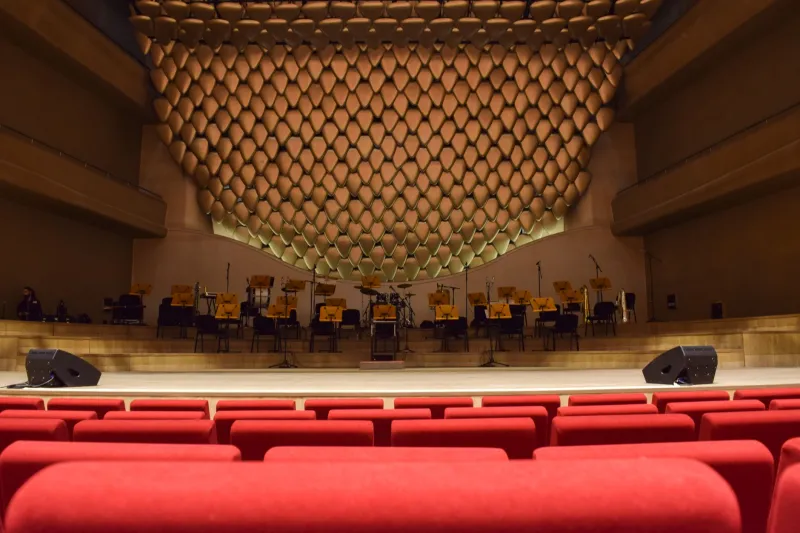
Consider the approach taken in the design of the Elbphilharmonie concert hall in Hamburg, completed in 2017. The building's acoustic design, led by Yasuhisa Toyota of Nagata Acoustics, was not layered onto an existing architectural concept but was constitutive of it. The wave-shaped roof, the specific curvature of interior surfaces, the textured panels lining the auditorium walls—each of these decisions was made in simultaneous conversation with acoustic modeling and architectural intent. The result is a room widely described as among the finest concert halls built in the modern era, one where the experience of music is inseparable from the experience of space.
In the United States, similar integration can be observed in projects such as the Walt Disney Concert Hall in Los Angeles, where Gehry Partners worked closely with acoustic consultant Minoru Nagata to develop a vineyard-style seating arrangement and wooden interior surfaces that produce what musicians and audiences consistently describe as an enveloping, warm acoustic presence. The hall's distinctive exterior form and its interior acoustic performance are expressions of the same underlying spatial logic.
The Quieter Cases
Acoustic design is not exclusively the province of performance venues. Its stakes are equally high—and perhaps more broadly consequential—in the spaces where Americans spend most of their lives: homes, schools, healthcare facilities, and workplaces.
In residential design, acoustic quality is increasingly recognized as a dimension of genuine luxury. The ability to sleep undisturbed, to hold a private conversation, to experience genuine quiet within an urban environment—these are conditions that require deliberate architectural attention. Mass timber construction, which is gaining significant traction across the American Pacific Northwest and increasingly in cities such as Denver, Chicago, and New York, presents interesting acoustic trade-offs: wood's natural warmth and thermal performance are well established, but its relatively low mass compared to concrete requires careful detailing at floor and wall assemblies to achieve adequate sound isolation between units.
In educational settings, the acoustic environment has direct consequences for learning outcomes, particularly for younger students and those with hearing differences or language processing challenges. The American National Standards Institute has published classroom acoustic standards—ANSI S12.60—that specify maximum background noise levels and reverberation times for learning spaces. Yet a substantial proportion of American school buildings fail to meet these standards, a fact that carries real educational costs that are rarely framed as architectural failures.
Sound as Spatial Identity
Beyond performance metrics, the acoustic character of a space contributes to something more difficult to quantify but no less real: its identity. Every significant building has a sound. The particular reverberation of Union Station in Washington, D.C., the specific ambient hum of the New York Public Library's Rose Main Reading Room, the way sound moves through the atrium of the Guggenheim Museum in New York—these qualities are as much a part of those buildings' meaning as their visual character.
This is the dimension of acoustic design that most directly connects to a broader philosophy of spatial experience. Architecture at its most serious is not the production of visually compelling objects but the creation of environments that support and enrich human life in its full complexity. Hearing is not a supplement to seeing; it is an equally primary mode through which human beings apprehend and inhabit the world. A building that attends only to what the eye perceives has addressed, at most, half of the experiential equation.
Toward a Fuller Spatial Literacy
The case for treating acoustic design as a core architectural discipline rather than a technical specialty rests ultimately on this argument: the quality of a space is the quality of the experience it affords, and experience arrives through every sense simultaneously. The most enduring buildings in human history—whether the Pantheon in Rome, the great mosques of the Islamic world, or the finest concert halls of the twentieth century—have understood this. Their power is not merely visual. It is total.
For practitioners and clients alike, developing genuine spatial literacy means learning to hear a building as attentively as one looks at it. It means asking, at the earliest stages of design, what this space will sound like at eight in the morning, at noon, at midnight. It means understanding that the decision to use polished concrete rather than acoustic tile, or to open a floor plan rather than subdivide it, carries acoustic consequences as real as its visual ones.
Architecture that neglects this dimension does not merely fall short of excellence. It fails its occupants in ways they may feel every day without ever being able to name precisely what is wrong. The buildings that endure—the ones that feel right in a way that resists easy explanation—are almost invariably those where someone, at some stage in the design process, thought carefully about what they would sound like from the inside.