Crossing Over: The Forgotten Power of the Threshold in American Architecture
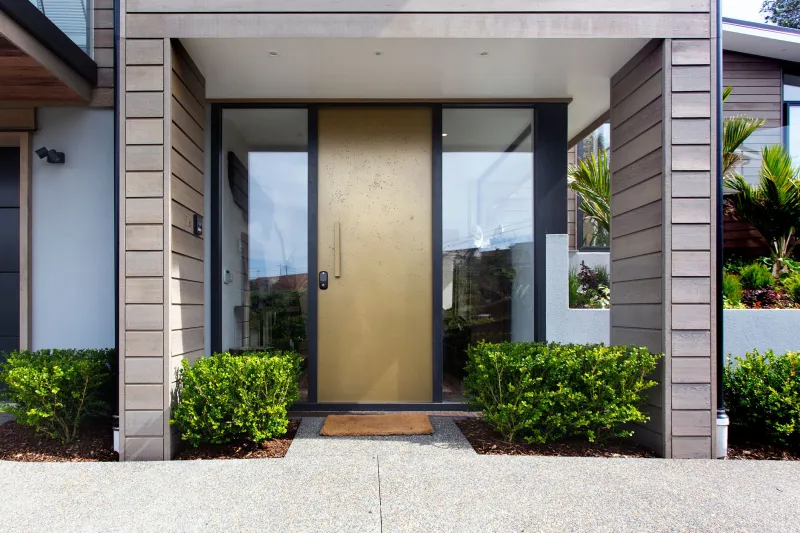
There is a moment, brief and almost imperceptible, that occurs every time you step from one room into another. Your body registers a change in air, in light, in acoustic texture. Your mind shifts its register, preparing for whatever the next space demands of it. This moment is the threshold—and for most of human history, architects treated it as one of the most consequential elements of a building's design.
Today, in much of contemporary American residential and commercial architecture, that moment has been nearly eliminated.
The Disappearing Boundary
The open-plan revolution that swept through American home design over the past four decades was, in many respects, a response to genuine social needs. Families wanted to feel connected across activities. Smaller square footage demanded visual expansion. Entertaining culture called for fluid, unobstructed gathering spaces. These were legitimate pressures, and the architecture responded accordingly.
But in dissolving walls, we also dissolved something less tangible: the ritual of passage. When a kitchen flows without interruption into a dining area, which opens seamlessly into a living room, the experience of arriving anywhere within the home is diminished. You are always, in a sense, already there—and also never quite anywhere at all.
This erosion of boundary has psychological consequences that designers are only beginning to fully reckon with. Neuroscientists studying spatial cognition have observed what has come to be called the "doorway effect"—the well-documented phenomenon in which passing through a physical threshold causes the brain to compartmentalize memory and intention. Walking through a doorway, researchers have found, triggers what is effectively a mental reset, filing away the context of the previous room and opening attention to new tasks and states of mind.
When thresholds are removed, this cognitive architecture is disrupted. The brain struggles to fully transition, to close one chapter of experience and open another. The result, in practical terms, is the low-grade restlessness many Americans describe in their own open-plan homes: the inability to fully relax in a living space that remains visually and acoustically continuous with a workspace, or the difficulty concentrating when the boundary between focused effort and casual leisure is architectural rather than physical.
What Traditional Architecture Understood
Pre-modern architectural traditions across cultures approached thresholds with a gravity that modern practice has largely abandoned. In Japanese domestic architecture, the genkan—the recessed entryway where shoes are removed and the outside world is formally left behind—functions as a decompression chamber between street and home. It is not merely practical. It is ceremonial. The act of stepping down, removing footwear, and stepping up into the home interior is a choreographed transition that signals, to both body and mind, that a meaningful change of context has occurred.
Similarly, the classical American foyer—now frequently treated as wasted square footage in new construction—once served as a buffer zone between public and private life. It was a space that belonged to neither world entirely, a room in which visitors were received without being admitted, in which the returning resident could shed the day before entering the home proper. Its gradual disappearance from residential design has not simply altered floor plans. It has altered the quality of arrival itself.
In sacred and civic architecture, the threshold has always been treated as a site of transformation. Cathedral narthexes, courthouse vestibules, museum entry halls—these spaces announce, through scale and materiality and sequence, that what lies beyond is different in kind from what came before. They prepare the visitor. They create anticipation. They make arrival meaningful.
Designing Thresholds with Intention
Restoring significance to the threshold does not require abandoning the openness that contemporary American living legitimately values. It requires, instead, a more nuanced understanding of how spatial boundaries can be established through means other than solid walls.
Changes in floor material—from hardwood to stone, from tile to carpet—can signal a shift in spatial identity without introducing any vertical obstruction. Ceiling height variations accomplish something similar, compressing space to create a sense of passage before releasing the occupant into a taller, more expansive volume. Lighting design, carefully calibrated, can define zones of distinct character within an otherwise continuous space, allowing the eye and the body to register arrival even where no door exists.
Where doors do exist, their design deserves far more deliberate attention than American residential practice typically affords them. The weight of a door—its mass, its resistance, the sound it makes when it closes—communicates something about the gravity of the space it protects. A heavy, well-hung door that closes with a soft but substantial sound creates a different psychological environment than a hollow-core door that swings loosely on its hinges. These are not merely aesthetic distinctions. They are experiential ones, registered by the body before the conscious mind has time to interpret them.
Architects working in the tradition of phenomenological design—a lineage that includes figures from Alvar Aalto to Juhani Pallasmaa—have long argued that architecture's primary obligation is to the embodied experience of the person moving through it. The threshold, by this understanding, is not a problem to be solved or a limitation to be overcome. It is an opportunity: a moment in which the building can speak directly to the body, orienting it, preparing it, marking the passage of time and attention in space.
The Workplace Threshold
The stakes of threshold design extend well beyond the home. In commercial and workplace environments, the absence of meaningful thresholds has contributed to what organizational psychologists describe as boundary collapse—the inability of workers to mentally separate focused effort from ambient social activity, or professional identity from personal one.
The open-plan office, like the open-plan home, was conceived as a solution to real problems: hierarchy, isolation, the inefficiency of siloed communication. But in eliminating physical boundaries, it also eliminated the spatial grammar that helps the brain organize experience. The result, in countless American workplaces, has been an environment that is simultaneously overstimulating and oddly directionless—a space in which workers are always together and yet rarely feel fully present.
Designers working to address this challenge are increasingly turning to threshold as a therapeutic tool. Entry sequences that slow arrival and signal transition. Small, enclosed rooms that require a deliberate act of entry and exit. Acoustic vestibules that separate conversation zones from concentration zones. These interventions do not restore the rigid hierarchies of the traditional office. They restore something more fundamental: the body's ability to know where it is and what that place asks of it.
Arrival as Architecture
At its deepest level, the question of threshold is a question about what we believe architecture is for. If a building's purpose is simply to shelter activity—to provide square footage within which life occurs—then thresholds are indeed inefficiencies, obstacles between one functional zone and another.
But if architecture is understood as a medium through which human experience is shaped and given form, then the threshold is among its most powerful instruments. It is the moment at which the building makes its most intimate contact with the person moving through it, marking time, registering change, and affirming that where we are matters—that the act of crossing from one space into another is not incidental, but meaningful.
To design a threshold with care is to insist, quietly but firmly, that arrival is worth something. In a culture that prizes speed and frictionlessness above almost all else, that insistence may be among the most radical gestures available to the contemporary architect.