The Material Instinct: Why What a Building Is Made Of Matters More Than You Think
There is a moment, familiar to anyone who has walked into a genuinely well-designed space, when the body registers something before the mind has had time to form an opinion. A warmth, a weight, a sense of rightness that precedes analysis. This response is not accidental. It is the product of material intelligence—the accumulated knowledge, encoded in human perception, of how the physical world behaves and what it means when a building chooses to speak in one material language rather than another.
Architects have always understood this. Builders have often forgotten it. And the American residential market, shaped by the economics of volume construction, has largely set it aside in favor of surfaces that simulate authenticity without embodying it. The result is a vast inventory of homes that are technically adequate and experientially hollow.
The Body Reads Before the Eye Does
Environmental psychologists have documented what architects have long intuited: human beings process material information through multiple sensory channels simultaneously. The eye registers color and surface variation. The hand registers temperature, texture, and resistance. The ear registers the acoustic behavior of a material—the way sound moves through concrete versus through timber versus through glass. Even the nose participates; the faint resinous scent of a wood-paneled room communicates something about aliveness and age that no photograph can reproduce.
This multi-channel reading happens faster than conscious thought. Before a visitor to a space has formed a verbal opinion about what they are seeing, they have already received a comprehensive material report—warm or cold, alive or inert, particular or generic, cared-for or indifferent. The emotional tone of an interior is established, in significant part, by this pre-cognitive material encounter.
Understanding this helps explain a phenomenon that puzzles many American homeowners: why a room that looks attractive in photographs feels somehow disappointing in person, while another room that is harder to photograph feels immediately right. Photography flattens material experience into visual information. The body, present in the actual space, receives the full report—and generic materials, however attractive in two dimensions, tend to fail the three-dimensional test.
Wood: The Material of Time
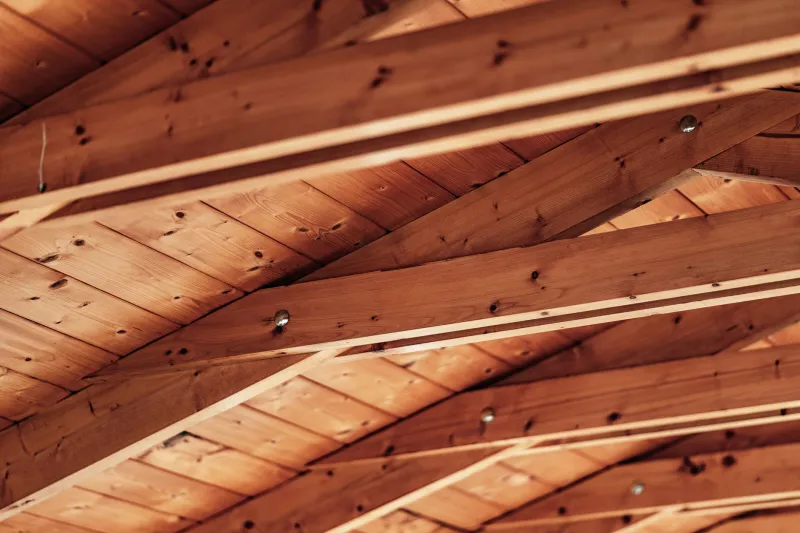
Of all the materials available to residential architects, wood carries perhaps the most complex emotional charge. It is the material that most legibly records time—in growth rings, in weathering patterns, in the way grain shifts from sapwood to heartwood. A wooden surface is not merely a surface; it is a document of process, of growth, of the specific conditions of a specific place over a specific span of years.
This is why mass-produced wood-look laminates, however technically proficient, fail to produce the same response as actual timber. They reproduce the visual pattern of wood without reproducing the temporal information encoded in genuine grain. The body, reading the material, registers the absence of that information as a kind of blankness—a surface that claims to say something and doesn't.
In Toyo Ito's residential work, wood appears not as decoration but as structural participant—as beams that carry weight and bear the marks of that labor, as flooring that develops a patina over years of use. The material is permitted to age, which is to say it is permitted to become more itself over time rather than less. This is a fundamentally different relationship to material than the one embedded in American renovation culture, where aging surfaces are typically replaced rather than honored.
Concrete and the Aesthetics of Honesty
Concrete occupies a peculiar position in American residential design. For decades it was associated almost exclusively with infrastructure—with highways, parking structures, and utilitarian construction. Its recent appearance in high-end residential interiors as an exposed, finished surface has been met with responses ranging from admiration to bewilderment.
The admiration is easier to explain than the bewilderment. Concrete is one of the most honest materials available to a designer. It records its own making—the marks of formwork, the variations in aggregate distribution, the subtle color shifts that document the pour sequence. A concrete wall is a wall that does not pretend to be anything other than what it is. In an architectural culture saturated with surfaces that simulate other surfaces, this directness has a quality that can only be described as relief.
The bewilderment arises from a mismatch between material and expectation. Americans have been conditioned, through decades of residential marketing, to associate quality with softness, warmth, and surface perfection. Concrete offers none of these things in conventional terms. It is cool, hard, and marked. But it is also, in the hands of a skilled designer, extraordinarily responsive to light—shifting from near-white at midday to deep grey at dusk, absorbing and releasing warmth in ways that connect the interior to the thermal rhythms of the day.
Glass and the Question of Exposure
Glass is the material of simultaneous presence—the material that allows a space to be in two places at once, interior and exterior, enclosed and open. It is also, in excess, the material of vulnerability. The widespread use of floor-to-ceiling glazing in American residential and commercial design has produced spaces that are visually spectacular and psychologically demanding—spaces where the inhabitant is perpetually on display, perpetually aware of the world beyond, perpetually unable to fully arrive.
The question a designer must ask about glass is not how much, but where and to what end. Glass that frames a specific view—a particular tree, a distant hillside, a contained garden—creates a relationship between interior and exterior that is curated rather than indiscriminate. The inhabitant is given something specific to look at, and that specificity produces a sense of connection rather than exposure.
Glass that simply opens a room to whatever lies beyond transfers the compositional decision to chance. The result may be beautiful or banal depending entirely on what happens to exist outside—a condition that no amount of interior refinement can fully compensate for.
Stone and the Weight of Place
Stone is the material most directly connected to geography. Limestone from Indiana, granite from Vermont, slate from Pennsylvania—these materials carry the specific geological history of a place in their color, texture, and weight. A stone floor is a floor that knows where it came from.
This geographic particularity is part of what makes stone feel grounding in the literal sense. It connects the building to the land beneath it, establishing a material continuity between the constructed and the natural that lighter, more processed materials cannot replicate. In an era when American homes are increasingly built from materials manufactured in facilities that could be located anywhere and assembled by workers who may never visit the site, the geological specificity of stone represents a meaningful resistance to placelessness.
Choosing Materials With Intention
The practical implication of all this is straightforward, if not simple: material selection deserves the same depth of consideration as spatial planning, structural engineering, or site analysis. It is not a finishing decision to be made from a catalog after the important work is done. It is a foundational decision that will determine, more than almost any other factor, whether a completed space feels genuine or generic.
For American homeowners working within renovation budgets, this often means making fewer material choices with greater commitment rather than spreading resources across a broad palette of acceptable-but-undistinguished surfaces. A single wall of book-matched walnut in a living room will do more for the felt quality of that space than an entire floor of mid-grade engineered hardwood. A concrete kitchen counter, properly sealed and used, will develop a character over years that no quartz composite can match.
Authenticity in materials is not a luxury. It is the difference between a space that asks to be lived in and one that merely permits it.