Designed to Remain Unfinished: The Architecture of Personal Evolution
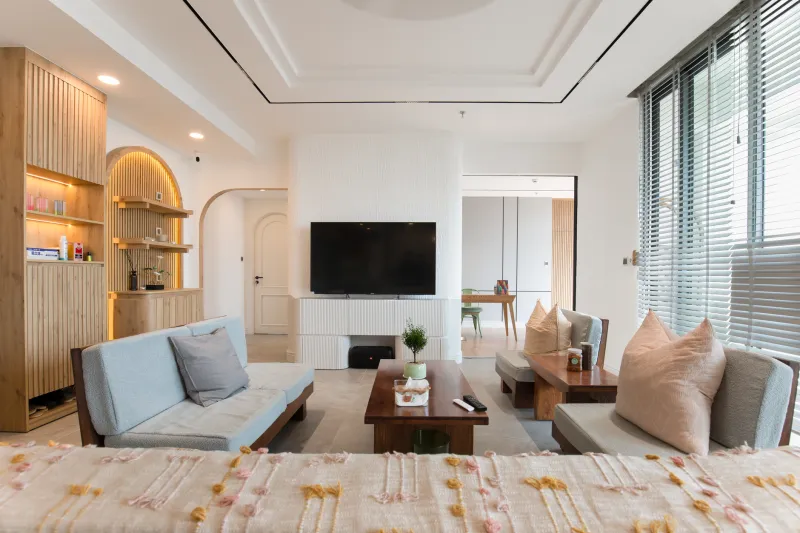
There is a particular kind of exhaustion that comes from living inside a room that has already decided what it wants to be. Every object placed with precision, every surface sealed and styled, every corner resolved—and yet the person living there has continued to change, to question, to grow in directions the original design never anticipated. The room becomes a costume. Eventually, it becomes a cage.
This is not a failure of taste. It is a failure of architectural philosophy.
The Tyranny of the Resolved Interior
American residential culture has long rewarded the fully realized interior. Home renovation television, design magazines, and social media platforms celebrate the reveal—the finished room, the completed transformation. What these formats rarely acknowledge is what happens after the camera crew leaves. Life resumes. Children age. Careers shift. Relationships deepen or dissolve. The person who commissioned that immaculate, precisely curated living room at thirty-four is, in meaningful ways, a different person at forty-two.
When an interior has been designed without tolerance for change, this evolution creates friction. Rooms that were built around a single function resist new ones. Furniture arrangements that were calculated for a particular lifestyle become obstacles to a different one. The architecture, rather than supporting its inhabitant, begins to subtly contradict them.
The psychological cost of this contradiction is underappreciated. Research in environmental psychology consistently suggests that a sense of agency over one's immediate surroundings contributes significantly to well-being. When a space feels immovable—when every element has been so deliberately resolved that alteration feels like vandalism—that sense of agency erodes. The home stops being a place of self-expression and becomes, instead, a kind of performance.
What Japanese Design Understood Long Before We Did
In Japanese architectural tradition, impermanence is not a problem to be solved. It is a condition to be honored. The concept of ma—the charged, meaningful interval of empty space—implies that what is left open is as significant as what is filled. Traditional Japanese interiors were designed with deliberate incompleteness: sliding screens that could reconfigure a room in minutes, minimal furnishings that could be rearranged or removed entirely, materials chosen for the way they would age and mark time rather than resist it.
This was not minimalism for aesthetic reasons alone. It was a philosophical position about the relationship between a dwelling and its inhabitant. The house was understood to be a living system, not a finished object. Its value lay partly in its capacity to accommodate the changing needs of those within it.
For Toyo Ito, this principle has informed decades of architectural practice. His work consistently resists the idea of the building as monument—a fixed declaration. Instead, his structures tend toward fluidity, toward spaces that invite reinterpretation. The architecture does not insist on a single reading. It opens a conversation.
Reinvention as an American Value
There is, perhaps, no cultural value more deeply embedded in American identity than the capacity for reinvention. From the frontier mythology to the startup narrative, Americans have always understood themselves as people who are not bound by their origins—who can, through will and effort, become something new. This is a remarkable and genuinely admirable cultural inheritance.
And yet American homes, paradoxically, are often designed in direct opposition to this value. They are built to declare an arrival, not to support a journey. The open floor plan—celebrated as a symbol of freedom—is frequently filled wall to wall with furniture that leaves no room to breathe, no margin for change. The master suite is designed as a destination, not a room that might one day need to become something else entirely.
The most human act of residential design may be the deliberate refusal to finish. To leave a wall unpainted not from neglect, but from wisdom. To choose furniture that can be moved, layered, or replaced. To build in alcoves and flexible spaces that do not yet know what they will become. To design, in other words, for the person the inhabitant has not yet had the chance to be.
Principles of the Adaptive Home
Adaptive design does not mean indeterminate design. A home that accommodates change still requires structure, proportion, and intention. The difference lies in where resolution is applied and where it is withheld.
Load-bearing elements—the bones of a structure—can and should be resolved with precision. But the surfaces, the partitions, the arrangements of objects within that structure benefit from a degree of openness. Rooms that can serve more than one purpose without extensive renovation. Storage systems that grow rather than constrain. Lighting that can be adjusted to support entirely different activities in the same space at different points in the day, or in a life.
Materials play a crucial role here. Surfaces that show use—wood that develops a patina, concrete that records the marks of daily life, plaster that can be repainted as a person's sensibilities evolve—are not inferior to surfaces that resist change. They are more honest. They acknowledge that the home is a living document, not a finished manuscript.
Architects working in the American residential context would do well to resist the pressure to deliver the complete statement. The client who asks for a fully resolved interior today is, in ten years, the client who feels trapped by it. The more generous gift is a framework: thoughtfully proportioned, structurally sound, and deliberately open to the futures its inhabitants have not yet imagined.
Space as Permission
At its most fundamental, the unfinished interior is an act of trust. It trusts the inhabitant to continue developing, to bring new meaning to a space over time, to make the house more fully their own with each passing year. This is architecture not as product, but as invitation.
The homes that people remember with the deepest affection are rarely the ones that were perfectly styled. They are the ones in which life accumulated—where a corner was claimed for reading, where a wall slowly filled with things that mattered, where a room changed purpose three times and was better for it each time. These homes did not resist change. They were designed, whether consciously or not, to welcome it.
Leaving space for change is not a design compromise. It is the highest form of residential intelligence—an acknowledgment that the person who will live in a home for thirty years is not the same person who commissioned it, and that both deserve a place to belong.