Sealed Against the Sky: What We Surrendered When We Perfected Climate Control
Somewhere in the middle of the twentieth century, American buildings stopped responding to the weather. Not immediately, and not all at once—but gradually, as mechanical systems grew more powerful and building envelopes more airtight, the interior of a structure became increasingly independent of the exterior conditions that surrounded it. The goal was comfort. The result was a kind of temporal erasure.
Walk into most American office buildings, shopping centers, or apartment complexes today and you will find the same air: filtered, conditioned, and maintained at a temperature chosen months ago by a facilities manager working from an average. It does not feel like February or July. It does not feel like morning or afternoon. It does not, in any meaningful sense, feel like a particular day in a particular place. It feels like a controlled environment—which is precisely what it is.
The efficiency of this arrangement is undeniable. The losses are harder to quantify, but they are real.
The Building as Climate Capsule
For most of architectural history, a building's relationship to its climate was not a design problem to be solved but a condition to be navigated with intelligence and craft. Vernacular builders in every region of North America developed strategies for managing seasonal extremes without mechanical intervention: deep roof overhangs that blocked summer sun while admitting winter light, thick masonry walls that absorbed heat during the day and released it at night, cross-ventilation systems that drew cool air through a building on hot afternoons, sleeping porches that acknowledged that summer nights were different from winter ones.
These strategies were not merely functional. They inscribed the passage of time into the experience of inhabitation. A house that was warm in winter through the thermal mass of its stone walls, and cool in summer through the shade of its porch, was a house whose occupants were continuously, subtly aware of where they were in the year. The building was a kind of calendar—not in a literal sense, but in the way it registered the world outside and translated that registration into daily experience.
The near-universal adoption of central heating and air conditioning in the postwar American building industry did not simply replace these strategies. It made them unnecessary, and in doing so, it severed a connection between interior life and natural time that had persisted for millennia.
The Psychological Cost of Perpetual Sameness
Human beings are deeply circadian creatures. Our cognitive function, emotional regulation, hormonal cycles, and sleep architecture are all organized around the rhythms of natural light and temperature that vary across the day and across the year. Decades of research in chronobiology have established that these rhythms are not mere biological background noise—they are fundamental to health, mood, and the capacity for sustained attention.
Buildings that eliminate variation in light and temperature do not simply fail to support these rhythms. They actively disrupt them. The American worker who spends eight to ten hours per day in a sealed, uniformly lit, temperature-controlled office is receiving a continuous signal from their environment that time is not passing—that there is no morning or afternoon, no autumn or spring, no reason for the body to adjust its chemistry in response to the world outside. The consequences include disrupted sleep, reduced alertness, elevated stress hormones, and a diffuse but persistent sense of temporal displacement that many people experience as low-grade fatigue or difficulty concentrating.
Residential architecture is not immune to this problem. The sealed, HVAC-dependent American home—with its double-paned windows designed to minimize thermal exchange, its blackout curtains blocking morning light, its mechanical ventilation circulating the same filtered air year-round—can be as temporally disorienting as any office building. The home that never smells like rain, that never admits a cold draft on a January morning, that never grows warm in the afternoon sun of late August, is a home that has been quietly disconnected from the world it occupies.
Designing for Seasonal Intelligence
The response to this condition is not a rejection of climate control. Mechanical systems are necessary, and in many American climates, they are essential to basic habitability. The question is whether those systems should be the only relationship a building has with its climate—whether the goal of architectural design should be the elimination of all variation, or the thoughtful management of it.
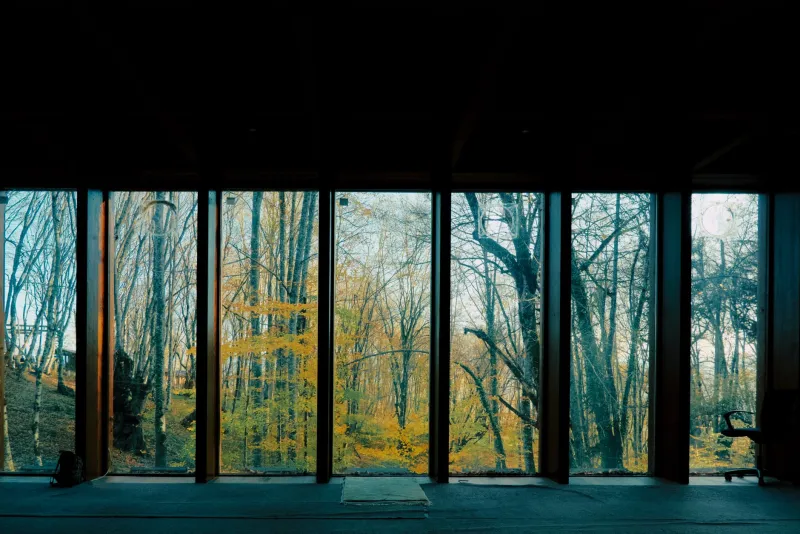
A growing body of work in biophilic design and environmental psychology suggests that buildings designed to admit controlled degrees of seasonal variation produce measurable improvements in occupant well-being. Windows sized and oriented to track the arc of sunlight across the year—admitting low winter sun while shading against summer overhead light—connect occupants to the daily and seasonal passage of light without sacrificing thermal comfort. Operable windows that allow fresh air during temperate months restore the sensory connection to outdoor conditions that sealed buildings eliminate. Materials that respond visibly to humidity, temperature, and use—wood that expands and contracts, plaster that registers moisture, metal that develops a patina—make the passage of time legible within the interior.
In Toyo Ito's architectural practice, this sensitivity to environmental responsiveness has been a persistent concern. His structures consistently engage with natural light, air movement, and the visual presence of the exterior world in ways that resist the hermetic quality of so much contemporary building. The architecture does not attempt to defeat climate. It attempts to mediate it—to place the occupant in a relationship with the natural world that is comfortable without being entirely insulated.
Restoring Temporal Awareness
There is a term in Japanese aesthetic philosophy—mono no aware—that describes the bittersweet awareness of impermanence, the beauty that arises from the recognition that things change and pass. It is a sensibility closely associated with the natural world: the cherry blossom that lasts only days, the autumn light that arrives at a particular angle for only a few weeks each year, the first cool morning of September that signals a shift in the season.
American building culture has, in its pursuit of comfort and efficiency, designed this awareness almost entirely out of the built environment. The sealed building does not register the cherry blossom or the autumn light. It registers nothing except the setpoint chosen by its mechanical system.
The architectural project of reconnecting interiors to seasonal time is, at its core, a project of restoring this awareness—of designing buildings that remind their occupants that they live in a world that moves, that changes, that has a past and a future. This is not nostalgia. It is a recognition that temporal awareness is not a luxury but a condition of full human experience.
A building that knows what season it is—that admits it, registers it, and shares it with the people inside—is a building that keeps its occupants, however subtly, in contact with the larger rhythms of life on earth. In an era of increasing disconnection from natural systems, that quality may be among the most important things architecture can offer.