The Return of the Wall: How Americans Are Rediscovering the Power of Enclosed Space
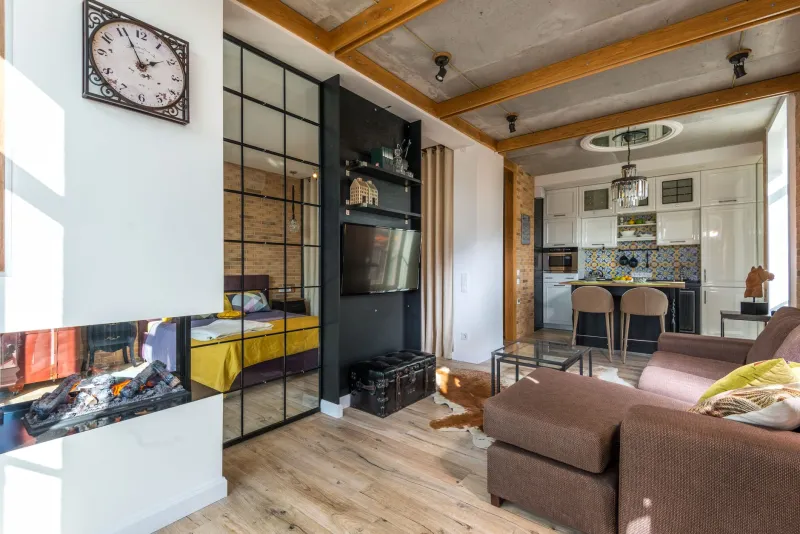
For two decades, the open floor plan reigned as the defining aspiration of American domestic life. Walls came down in living rooms from Portland to Philadelphia. Kitchen islands stretched to baronial lengths. The visual promise was irresistible: light flooding unimpeded from one end of a home to the other, a family in easy communion, a life organized by flow rather than partition. Now, a quiet but unmistakable reversal is underway — one driven not by trend but by the accumulated weight of how we actually live.
Understanding why walls are returning is, at its core, a question about the relationship between spatial form and human need.
The Promise That Didn't Translate
The open-plan ideal drew its legitimacy from modernist design principles — particularly the mid-century belief that transparency and continuity between spaces could dissolve social barriers and democratize domestic life. There is philosophical merit in that position. But translating a design ideology into a functional family home requires confronting a more stubborn reality: human beings require not only connection, but separation.
The lived experience of open-plan living, particularly since 2020, revealed its limitations with unusual clarity. When homes became simultaneously offices, classrooms, gyms, and refuges, the absence of enclosure — once celebrated as liberation — began to register as deprivation. A parent conducting a video conference while a child attended a remote class in the same undivided space was not experiencing the free-flowing domestic ideal. They were experiencing something closer to spatial conflict.
Psychological research has long supported what intuition suggests: enclosed spaces provide cognitive relief. Studies in environmental psychology consistently demonstrate that spatial boundaries reduce ambient distraction, lower cortisol levels, and support deeper concentration. The open plan, for all its visual generosity, was in many cases an architecture of performance — spaces designed to be seen rather than fully inhabited.
What Compartmentalization Actually Offers
The desire to rebuild walls is not, as some design commentators have framed it, a retreat from modernism. It is something more nuanced: a reassertion of the principle that different activities deserve different spatial conditions.
Consider what a defined room does that an open zone cannot. It establishes acoustic containment — a condition that matters enormously in an era when domestic noise has become a legitimate source of stress. It creates a threshold, a moment of transition between one mode of being and another. It allows a space to hold a singular identity rather than negotiating perpetually with its neighbors. A room can be a study, genuinely — not a corner of a larger room that aspires to studious behavior while competing with the kitchen's sounds and smells.
In architectural practice, the reintroduction of enclosure need not mean the abandonment of light or spatial generosity. The more sophisticated approach — one that draws on principles foundational to contemporary Japanese architecture — recognizes that boundaries and openness are not opposites. They are complementary conditions that, when calibrated thoughtfully, produce spaces of genuine richness.
Strategic glazing within newly enclosed rooms can preserve light transmission while establishing acoustic and visual separation. Partial-height partitions, translucent panels, and carefully considered doorway proportions allow a home to breathe without dissolving entirely into a single undifferentiated volume.
The Aspirational Gap
There is a tension worth acknowledging honestly. The open floor plan became not merely a design choice but a cultural signifier — evidence of a certain taste, a certain income, a certain orientation toward modernity. For many American homeowners, dismantling that arrangement carries a psychological cost that is distinct from the practical one.
This is where the conversation about domestic architecture must be conducted with particular care. The question is not whether open plans are inherently inferior, but whether the spaces we inhabit are genuinely serving the lives being lived within them. A design philosophy that privileges appearance over function — that asks residents to adapt their behavior to the demands of a spatial ideal rather than shaping space to support actual need — has misunderstood its purpose.
The most enduring residential architecture does not demand sacrifice from its occupants. It is generous in a deeper sense: it anticipates the full range of human activity, from focused solitary work to communal gathering, and provides the spatial conditions each requires.
A More Honest Modernism
What is emerging in American residential design is not a rejection of modernism's core ambitions — light, clarity, connection to the exterior, honest use of materials. It is a correction of one of its more dogmatic expressions. The open plan was always a means, not an end. When the means began to undermine the end — when transparency produced distraction rather than connection — a recalibration became necessary.
The homes being built and renovated now, by architects and homeowners willing to think carefully about spatial experience, tend toward a more differentiated approach. Rooms return, but they are not the dim, isolated chambers of pre-modernist domestic architecture. They are enclosed but permeable, defined but connected — spaces that know what they are without being indifferent to what surrounds them.
This is, in its way, a more demanding form of design. It requires thinking not only about how a space looks from a single vantage point, but how it functions across the full texture of daily life: morning routines, afternoon work sessions, evening gatherings, the particular silence a child needs to read, the particular openness a family needs to share a meal.
The wall, it turns out, was never the enemy of good living. Used with intelligence and intention, it is one of architecture's most powerful instruments for making a home genuinely habitable.